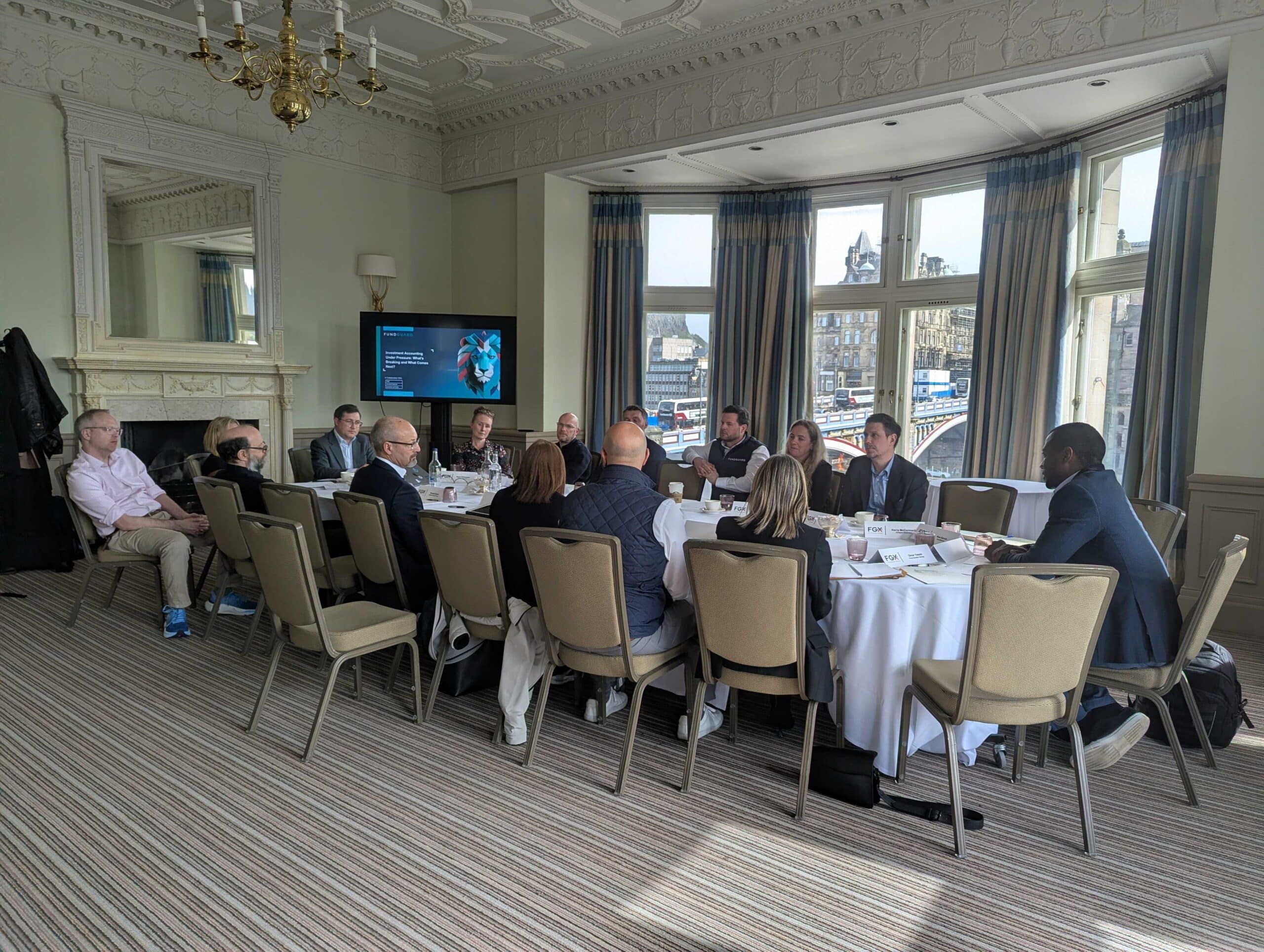
Last week, we at FundGuard hosted a roundtable in Edinburgh that brought together asset management leaders to talk about something the industry has been circling for a while now: how do we, in the asset management industry, build operating models that can actually keep up with the pace of change, when the data and provider ecosystem underneath them hasn’t kept up at all?
It was a fun, candid conversation and we like to think our audience got lots out of it. Much less was said about technology in the abstract and the focus was instead more on the friction that’s still defining day-to-day work inside oversight, accounting, IT and operations teams.
For anyone who couldn’t make it, here are some notes on what was discussed, as well as the key takeaways that you may find most useful.
Most Oversight Isn’t Really Oversight
The conversation opened on something that’s quickly becoming one of the industry’s most uncomfortable truths: teams labelled as oversight functions are spending most of their time working on manual low-level work such as chasing data, converting formats, and reconciling inconsistencies before they can even begin to do the work the role is named for.
One participant put it sharply: of everything being called NAV oversight today, the group estimated only around 40% is real oversight. The rest is data preparation that leadership is incorrectly calling oversight.
This isn’t the fault of the teams doing the work; it’s a structural issue. Oversight teams are receiving fragmented information from multiple sources, in inconsistent formats, with no shared definitions across providers. The job of checking the data has become inseparable from the job of assembling the data, and the assembly is consuming most of the capacity.
The PDF Problem and Why AI Isn’t the Answer
The example that came up several times and got the most knowing nods around the table was the persistence of PDFs in provider communication. Asset managers are still routinely receiving information from administrators as PDFs, manually extracting it into Excel and then unifying it across whichever internal systems need it.
Several participants correctly noted that AI can now do the extraction step. PDFs: in, results in structured data: out. But the room was clear that this is treating a symptom, not the cause. AI-assisted PDF extraction is merely a workaround. It makes a broken process slightly faster, but it doesn’t fix the broken process.
The deeper question is why PDFs are the medium in the first place and that led the conversation somewhere more interesting.
The Problem Isn’t Usually the Asset Manager
A recurring thread through the discussion was that the friction most firms are experiencing is actually located in their provider ecosystem. So many of the attendants are experiencing some mix of the following:
- Different administrators use different formats, definitions and communication methods
- Sometimes different teams within the same administrator use different formats from each other
- Public and private markets often operate in entirely different languages
- Asset managers are left interpreting all of it and translating it into something usable across their own organisation
One participant shared that their firm works with eight to ten administrators. The honest reality is that no asset manager has the leverage to change that ecosystem alone. Even consolidating provider relationships only goes so far; the group agreed scale gives you more influence, but it doesn’t solve the underlying lack of common standards.
There was a clear appetite in the room for a more unified industry approach, such as a shared utility, minimum data package, or something else that could move the sector beyond bespoke feeds and provider-by-provider interpretation.
Build, Buy, or Stop Pretending the Spreadsheet Is a System
The build versus buy question came up, as it always does. Most firms agreed that the reality they were facing was that they continue to depend on a mixture of legacy processes and in-house tools that have grown organically over years.
But there is a strong risk profile to these tools. Firms relying on internally developed solutions often find that the knowledge sits with a small number of people. If those people leave, the knowledge leaves with them. Everything from documentation to hiring to agility becomes harder to maintain over time, not easier.
Modernization costs money and building in-house carries its own risks, but on the other hand, buying carries the risk of being locked into a provider whose roadmap doesn’t match yours. Ultimately, there was no clean answer. What they did agree on is that the question has to be asked deliberately, with clarity about what each project is for, what it will take to deliver and how the operating model should work afterwards.
AI: Useful, But Not the Headline
For all the discourse around AI in the industry right now, the Edinburgh group was very grounded about what it can and can’t do.
The consensus was that AI has existed for years, but it’s only now become usable in day-to-day operations. It can help, particularly with detection and pattern-matching, but it cannot replace human judgement, and it needs careful governance, particularly around data lineage, quality control and any process that’s critical to the firm.
There was a real concern in the room about AI being used in ways that reduce transparency. People, rightly, still want to check whether the data provided by AI is correct. The good news, one participant noted, is that AI tends to make errors easier to spot, but only if there’s a person in the loop looking for them.
The group was also wary of the way AI and automation are sometimes blurred together in industry conversation. They’re not the same thing. Tokenization, blockchain and eventually quantum computing all sit in the same broader bucket of technologies that will matter, but firms have to be practical about what each one can actually solve today, rather than treating AI as a shorthand for the future.
Resilience as a Discipline, Not a Drill
Operational resilience came up several times, and the framing was consistent: testing resilience isn’t about checking what happened after a problem occurred, it’s about being prepared before something happens, and identifying issues before they turn serious.
The group didn’t feel that oversight or resilience expectations had necessarily increased in substance, but what has changed is the level of clarity required. Firms are being asked to evidence their oversight, their resilience and their controls more explicitly than they used to be and the work of proving resilience has grown faster than the underlying obligation.
What People Want From Their Providers (And Aren’t Getting)
One of the more pointed parts of the discussion was about what asset managers want from their technology and service providers, as well as what they’re often not receiving.
The room wanted systems and data that work across teams, as opposed to solutions that solve one function in isolation, as well as wanting common data and common systems that support the whole operating model, rather than another point tool.
They also wanted more proactive input from suppliers. Provider sales teams hear the same pain points from multiple clients. The group felt strongly that there was an opportunity for those suppliers to share insights more openly and help the industry work toward collective solutions, rather than treating every conversation as a one-off sales cycle.
The Real Future of Asset Management is FundGuard
The roundtable closed with broad agreement that this conversation needs to keep going. Several specific themes were flagged for future sessions:
- Governance for AI in critical processes
- The design of modern operating models
- What a minimum standardized data package across the sector might look like
- How the industry can move from isolated technology projects toward a more connected and resilient way of working
The honest picture from the room was that the sector understands what needs to change, but that there is still a wide gap between that understanding and the operational reality, which is still defined by fragmented data, inconsistent provider communication and legacy ways of working. The opportunity now is to close that gap deliberately rather than waiting for it to close itself.
If you’d like to be part of the next FundGuard roundtable, join the FGX community here.