Key Takeaways
- Agentic AI reads data, makes decisions and takes actions. To do that safely, it needs a system of record that exposes trusted, real-time accounting data through APIs, preserves every event in an immutable history and provides complete lineage for every decision it makes.
- Batch processing, fragmented asset-class books and overwrite-based data each remove something an agent depends on. Models can run effectively, but they cannot operate properly.
- The recent Funds Europe Top 200 survey of global asset managers shows the operational pressure AI is meant to relieve: concentration at the top, a widening efficiency gap and around one in five employees at Top 50 firms working in money management.
- A single system of record holding public and private assets, event-driven and API-first is the data foundation agentic AI runs on.
For two years, the conversation on AI in asset management has focused on models: which tasks could be automated, which reports a model could draft and where to run a pilot. The serious planning now is to enable agents to effectively make decisions and take actions with the best supporting system possible.
The data layer has received far less attention than models, yet it will do more than anything else to determine whether agentic AI succeeds. What sits underneath an agent decides whether or not it works. In investment accounting that underneath is the book of record, and its architecture sets the ceiling on what any agent built above it can do.
The Prize and the Pressure
The European Fund and Asset Management Association estimates that European asset managers can capture productivity gains of 25 to 30% from AI across investment, distribution and risk functions. For an industry under sustained fee pressure, that is the difference between scaling profitably and scaling into cost.
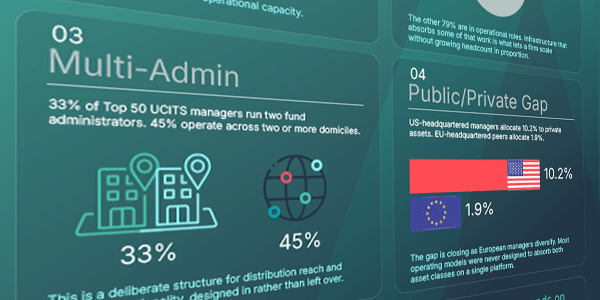
In the Funds Europe Top 200 survey, we see that the top 10 managers grew assets 17% last year and now hold 46% of the entire Top 200’s AUM. The bottom quartile contracted, while growth is concentrating at the top. Most importantly, it is concentrating around operational capacity. Across the Top 50, around one in five employees works in the full-time management of money, while the rest of the team runs the operational machine underneath them. US firms in the survey manage €1.78 billion of global AUM per money-management employee, against €1.35 billion at European firms. AI is the most plausible route to closing this efficiency gap.
Lior Yogev, CEO of FundGuard, says that asset managers face fee pressure while trading volumes, asset complexity and operational risk all climb. “People need to do so much more with less.” AI is how that gets done. Whether the infrastructure underneath the AI will let it is the open question.
Why Batch Architecture Breaks Agents
Agentic AI fails on legacy infrastructure for four reasons.
Current State
An agent reasoning about a position, a NAV, a reconciliation break or a corporate action is deciding what is true right now while batch architecture only resolves data into final form after the overnight cycle runs. Hand an agent last night’s extract and it reasons with full confidence about a world that has already moved on.
Action
Agents write back, correcting a record, updating a position, releasing an exception and triggering the next step in a workflow. A platform that exposes its data through reports and screens gives an agent plenty to look at and nothing to touch. Read-write APIs are what is required.
Explainability
Every decision an agent makes has to carry a trail of what it knew, when it knew it and how the record has changed since. Overwrite-based systems are where this falls apart. The moment a correction lands and the previous state is written over, the lineage that an agent’s reasoning and a regulator’s review both depend on disappears. Bitemporal accounting keeps it, by preserving every version of every record against both the economic date and the system date.
Breadth
A multi-asset mandate scattered across separate systems, with listed equity in one, derivatives in another and private credit somewhere else, gives an agent a partial view of a portfolio whose most valuable signals live in the relationships between holdings.
Most investment accounting platforms in production today were built around overnight cycles, fragmented asset-class books, overwrite-based data and on-premise hardware. Together they describe a foundation an agent cannot reliably operate on and they explain the pattern the whole industry is now watching: a pilot that dazzles paired with a rollout that stalls.
What Real-Time Data Gives an Agent
Real-time investment accounting means that a book of record updates as events arrive, so position, cash, valuation and exposure data show the current state at any moment. An agent reading that book is reading something current and can therefore act on what is true.
Several properties make this work, and they depend on each other.
- Event-driven processing treats every trade, price update, cash movement and corporate action as a discrete event that updates the record the moment it arrives
- API-first design means every capability the platform offers is reachable programmatically, so an agent can do through the API what a human operator does through the screen
- Bitemporal data preserves the history the agent needs to explain itself
- A single system of record holds public, private and digital assets in one engine, with native support for the lifecycle requirements of each asset class, so the agent reasons across one dataset
Private assets do not produce real-time data the way listed securities do. Capital calls, distributions and quarterly valuations arrive on their own schedules and no accounting platform changes the cadence of a GP’s reporting. What a unified system does is hold the latest known state of the private book alongside the real-time public book in one place, so an agent reasoning across the portfolio works from one coherent record instead of reconciling several.
FundGuard built toward this from the start.
Lior Yogev describes the platform as designed “API first” and with AI in mind from day one, before the current wave of generative AI arrived. The intent was anomaly detection, automation, reduced operational risk and better use of operational data, all running against a single source of truth. “If you don’t have systems of record you can work with in real time, through APIs,” he says, “you’re just not going to be able to compete in the long run.”
The Order of Operations
Real-time, event-driven, API-first accounting gives the agents built on top of it something solid to work from. Agents running on overnight batch systems keep producing the gap between what AI promises and what it delivers, a gap usually blamed on the model when it belongs to the structure underneath.
For asset managers, asset servicers and asset owners planning the next two years, sequence is the thing worth holding onto. Your data layer must come first. Intelligence built on top works as well as the foundation underneath allows, and no better.
Read the full Funds Europe Top 200 report.