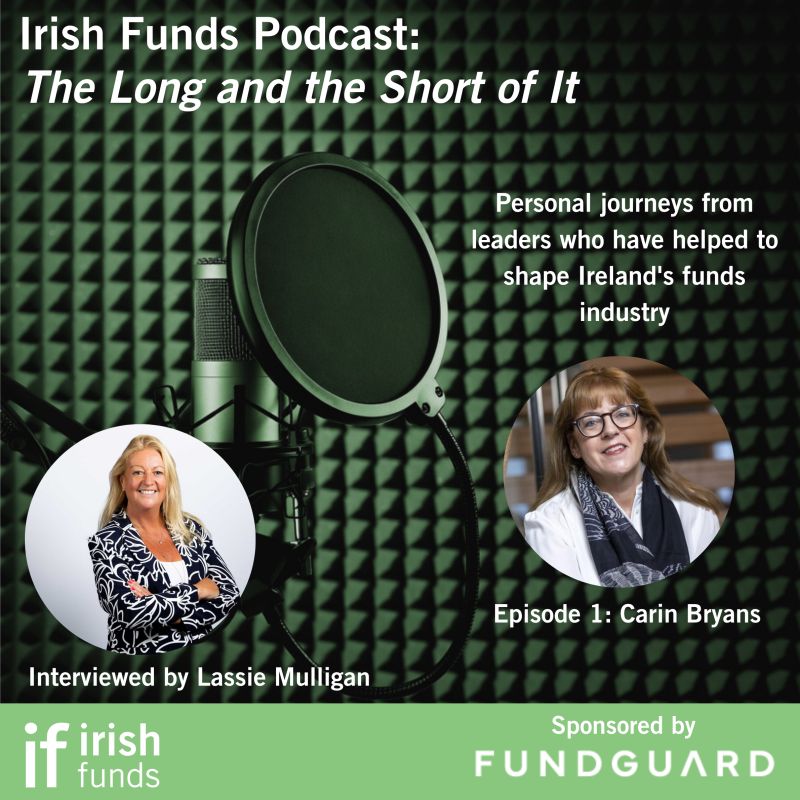
When Carin Bryans joined Chase Manhattan in Dublin around 1990, she was one of five people helping establish its Irish funds operation.
She didn’t know much about funds. Neither, by her account, did most of the people around her.
The team answered phones, fixed printers, joined sales meetings, calculated NAVs and handled fund accounting and transfer agency. When Chase later replaced its fund accounting system, Carin led the Dublin side of the project, working with colleagues across the UK, Luxembourg and the US.
More than 30 years later, Ireland’s funds industry looks very different. Irish Funds reports that Ireland is now the third-largest investment fund centre globally and the second-largest in Europe, accounting for 6.8% of worldwide fund assets and 21.8% of European fund assets. Assets in Irish-domiciled funds reached €5.5 trillion in 2025, supported by €436 billion in net inflows.
Carin’s story, as recently told to Irish Funds, is a reminder that industries of that scale are built by people making decisions, learning as they go and adapting to circumstances they could not have fully anticipated.
That is what makes The Long and Short of It, the new Irish Funds podcast series sponsored by FundGuard, so interesting.
The four-part series deliberately moves away from the usual discussions about markets, regulation and products. Instead, it asks some of the people who helped shape the industry about the experiences, choices, relationships and setbacks that shaped them.
And while the series is rooted in Ireland, the conversations are relevant well beyond it.
Ireland has spent more than three decades supporting investment managers from around the world as they develop and expand their international businesses. Irish Funds describes an ecosystem spanning fund administration, transfer agency, depositary, legal, tax, audit, compliance and consultancy services, with more than 20,000 funds professionals working in the country.
The issues those firms are dealing with today are familiar across the global asset management community: more complex portfolios, continued growth in private markets, new investment products, changing regulation and technology that is advancing faster than the operating models around it.
Carin has already lived through one period when the industry was changing dramatically, which makes her perspective on the next one worth hearing.
Experience still counts
One of the most interesting exchanges in the episode comes almost immediately. Asked whether AI will fundamentally change every job in financial services, Carin says no.
Her reason? Human relationships.
AI will change how people inform themselves and how they work, she says, but trust and relationships between people will remain critical. Later in the conversation, she makes a related point about experience.
People who have spent years in the industry know how to assess information, make judgment calls and understand what questions to ask. Her concern is for younger people entering the workforce: as AI assumes more tasks, how do they build the knowledge and experience that allow them to challenge the output? This is an important question for an industry moving quickly to adopt AI.
There is no shortage of discussion about what AI can automate, but what has to be true before firms can rely on it?
For investment operations and accounting, that starts with the information AI is working from. If data remains fragmented across multiple systems, books and reconciliation processes, adding AI does not resolve the underlying problem. It gives firms another way to interact with it.
This is an area we spend a great deal of time thinking about at FundGuard. AI can play a meaningful role in onboarding, reconciliation, exception management, document processing, diagnostics and other operational workflows. Firms are also beginning to consider how their own AI models and agents can interact directly with accounting systems.
For either to work well, the underlying accounting data has to be trusted, current and traceable.
That is less exciting to talk about than the latest model or agent, but it matters considerably more once AI moves from experimentation into actual investment operations.
Careers are rarely as planned as they look afterwards
Carin’s career is also a useful antidote to the tidy career histories we tend to see once someone reaches a senior position.
She moved from Ireland to Texas at 18, then to Paris, then back to Ireland. She joined Chase after seeing an advertisement in a newspaper. She considered moves to Russia and New York but stayed. A boss encouraged her to pursue an MBA. Other mentors pushed her into lateral roles and encouraged her to spend more time engaging with people outside the firm.
She stayed at J.P. Morgan for more than 30 years, not because she had mapped out a three-decade career there, but because she kept finding something new to do.
Asked what she would tell someone earlier in their career, she says she would have taken more risks herself: Don’t wait for the perfect opportunity to arrive. Go looking for it. Keep learning. Build relationships. Get outside your comfort zone.
That advice feels particularly relevant now, as people entering financial services today will probably work through more technological change during their careers than any generation before them. The specific systems, tools and skills they start with will change exponentially, so the ability to learn, make good judgments and build relationships will travel much further.
Getting outside the organization matters too
Carin also talks candidly about networking. Earlier in her career, she did not see it as especially important. That changed as mentors encouraged her to engage more with the industry and as she watched people such as Marie O’Connor build relationships across it.
Later, as a senior leader, her role increasingly included engaging with regulators, government, politicians and peers outside her own organization. This matters for institutions as much as individuals.
Asset management does not operate neatly within organizational boundaries. Managers, asset owners, servicers, technology providers, custodians, consultants and regulators are all dealing with different parts of many of the same changes, so there is obvious value in comparing notes.
That is part of a broader responsibility we believe the industry shares: creating opportunities for people across firms and functions to exchange perspectives, learn from one another and help move the industry forward. It is also why initiatives like The Long and Short of It matter.
Not every useful industry conversation needs to produce an immediate solution. Sometimes hearing how somebody else dealt with a difficult decision, built something new or changed their own thinking is useful enough.
The people behind the infrastructure
The funds industry spends a lot of time talking about technology, market, data and regulatory infrastructure infrastructure, but Carin’s conversation is a good reminder that there is another kind.
Industries accumulate knowledge through people. Through the teams that built early operating models, the people who made mistakes and fixed them, the managers who taught the next generation and the relationships developed across firms and markets over decades.
That knowledge matters even more as technology changes.
Towards the end of the podcast, Carin is asked what really matters after more than 30 years in the industry, and her answer has very little to do with titles or professional accomplishments: Values, friends and family, relationships, enjoying yourself, staying curious and ignoring some of the noise.
There is plenty in the episode about leadership, AI, diversity, workplace culture and the future of financial services. But perhaps the most useful part is simply hearing somebody who has watched an industry grow from a handful of people in an office describe what she learned along the way.
The Long and Short of It is a four-part Irish Funds podcast series sponsored by FundGuard and released ahead of the Irish Funds Annual Global Funds Conference in Dublin on October 1. Listen to the first episode with Carin Bryans and follow Irish Funds for the remaining conversations in the series.