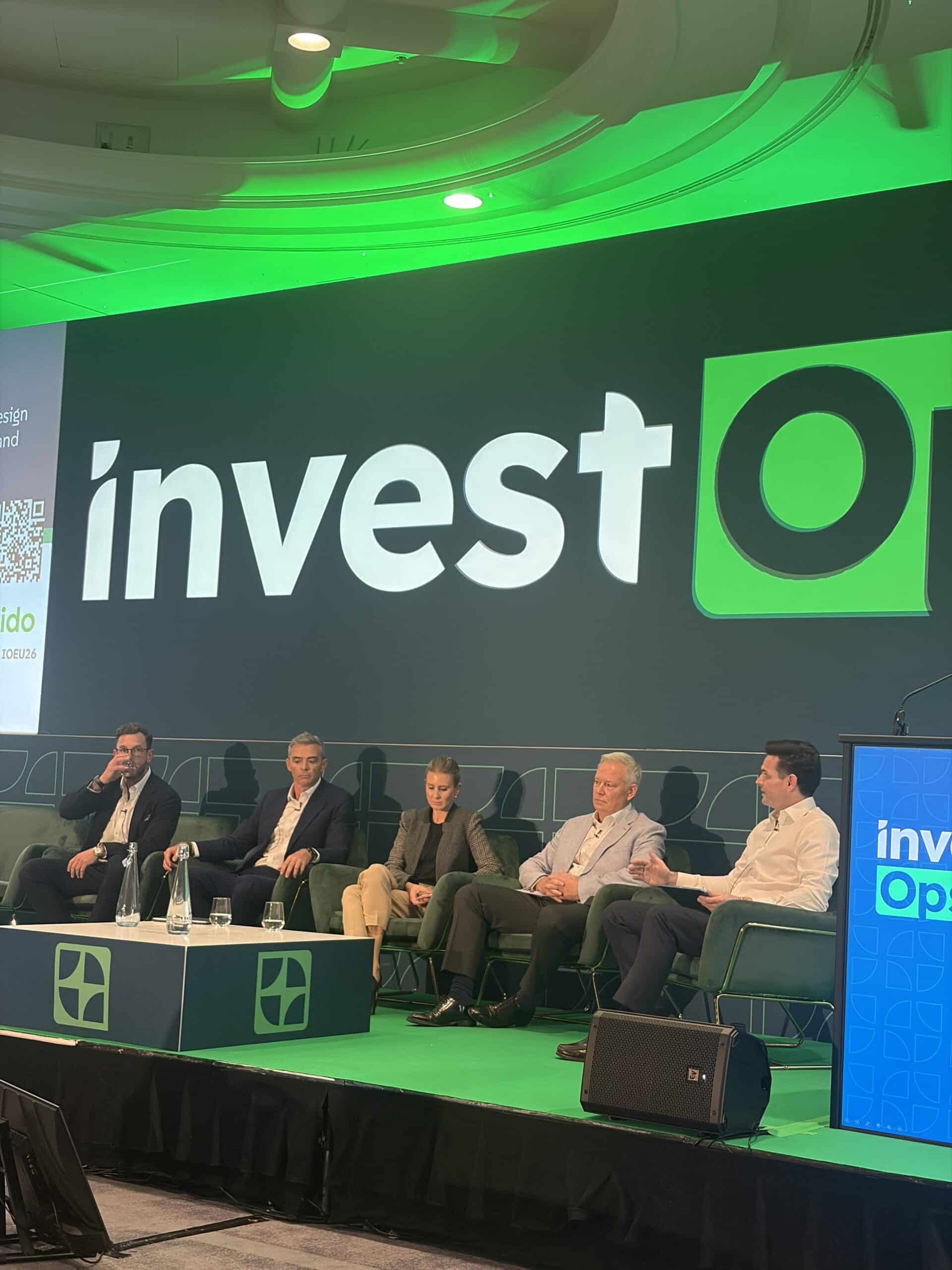
Public and private market convergence is becoming a familiar theme across investment management. But after moderating a discussion on the subject at InvestOps Europe in London, I came away thinking that convergence may be too simple a word for what firms are actually trying to accomplish.
I was joined by Andrew Austen, Director Investment Operations, COO Institutional Retirement at L&G; Danielle Johnston, COO Europe at Principal Global Investors; Colin O'Donovan, Director, Head of Global Funds Operations at Clearstream; and Alun Cutler, Executive Director, Commercial Development at SimCorp.
We did not agree that public and private markets should simply be brought together operationally. Nor should we have.
Real estate is not a listed equity. Private credit is not a government bond. Capital calls, lockups, documentation, valuation cycles and lifecycle events introduce requirements that do not disappear because an institution wants a consolidated portfolio view.
What emerged instead was a more nuanced question: where does consistency create value, and where does specialisation need to remain?
For asset managers, asset owners and asset servicers confronting growing private-market allocations, I think that is the more useful way to approach the problem.
Start with the view the business needs
At the portfolio level, the case for bringing public and private investments together is compelling.
Investment and risk teams need to understand exposures, liquidity, cash and capital across the portfolio. A decision involving one asset class can have consequences elsewhere. Growing private allocations affect liquidity requirements. Capital needs have implications for public holdings. Market events need to be understood in the context of the entire portfolio rather than through individual asset-class silos.
The panel discussion repeatedly returned to this idea of a total portfolio view. The objective is not to pretend that every underlying asset behaves alike. It is to give decision-makers sufficiently consistent information to understand the portfolio as a whole.
That becomes harder when the information itself operates on different clocks.
A listed security might have a price from minutes ago. The latest valuation of a private asset may be weeks or months old. Cash flows may be expected but uncertain. Some information arrives through structured feeds while other information remains buried in documents.
A useful consolidated view therefore cannot imply a false consistency in the underlying data. It needs to tell you not only what you know, but what you knew when, when the underlying information was effective and what has changed since.
This is where accounting architecture becomes particularly important.
For FundGuard, bitemporal accounting is part of how we address that problem. Maintaining both the effective date of an economic event and the date the system learned about or recorded it allows firms to preserve the history of what was known at a particular point in time while incorporating information that arrives later.
That matters when one portfolio contains assets operating at very different speeds. A unified view should not flatten those differences. It should make them intelligible.
Standardise where it helps. Specialise where it matters.
One of the strongest themes from the discussion was that there are layers of the operating model where greater consistency makes sense.
Data governance is one. Controls are another. Common definitions, reporting structures, connectivity and reconciliation can all make it easier to manage investments across asset classes.
But beneath that common layer, lifecycle processing can be very different.
Private-market investments can involve drawdowns, lockups, gates, complex legal documentation and asset-specific valuation processes. Real estate introduces information and workflows that bear little resemblance to those associated with listed securities. Private credit brings another set of requirements.
Trying to force all of that into workflows designed for public markets does not create convergence. It simply relocates the complexity.
The architecture therefore needs to accommodate both commonality and difference.
That is an important distinction for us at FundGuard. We believe there is significant value in being able to account for public and private assets on one platform and one transactional foundation. But that does not mean every client needs to reorganise its operations around a single integrated workflow.
An asset owner pursuing a total portfolio model may want a highly integrated approach. A large asset manager may retain specialist teams by asset class. An asset servicer may need to support different operating models for different clients, products or jurisdictions.
The technology should not dictate which model they choose.
It should give them the option to bring more together where doing so creates value, while interoperating with specialist systems and workflows where those remain appropriate.
Interoperability matters as much as consolidation
That leads to another important implication.
Modernisation cannot depend on every component of the investment ecosystem being replaced at once.
Institutional operating models contain portfolio management systems, accounting platforms, administrators, custodians, data providers, document repositories and specialist private-market applications. Those environments have developed over years, often differently across businesses and jurisdictions.
The practical question is therefore not simply, Can one platform do more?
It is also, Can the architecture connect what should remain separate?
Open APIs, consistent data models and interoperability allow firms to modernize progressively. A common accounting foundation can coexist with specialist systems. Data can be brought together for portfolio-level oversight without requiring every underlying process to become identical.
This is particularly important as firms expand private-market capabilities. The destination may be greater integration, but the route there will differ considerably by institution.
Scale exposes the manual work
The conversation also highlighted a basic problem with private-market growth: operational complexity tends to grow with assets.
Much of the industry still depends on people opening documents, interpreting terms, entering information into spreadsheets, reconciling data between systems and moving information manually from one workflow to another.
That model can work at relatively modest volumes. It becomes increasingly difficult when allocations grow or when private-market products reach larger investor populations.
Adding assets should not require adding operational headcount at the same rate.
This is one area where AI is already becoming useful, and importantly, the discussion stayed focused on practical applications rather than AI as an abstract proposition.
Document extraction is an obvious example. So are reconciliation, data classification and the ability to interrogate large bodies of information without manually navigating multiple applications and documents.
The opportunity is not simply to automate existing tasks faster. It is to move experienced people away from finding and assembling information and towards interpreting exceptions and making decisions.
But there was an equally important caveat: automation does not remove accountability.
Private assets often require judgement. Accountants, lawyers, investment professionals and operations specialists still need to understand the information and be responsible for the decisions made from it.
AI can reduce the work required to reach that point. It should not obscure how the answer was reached.
The next challenge may be volume
The discussion eventually moved to another development that could put these operating models under even greater pressure: broader access to private markets.
As private-market products reach wealth and retail channels, processes originally built around relatively small numbers of institutional investors may need to support dramatically greater transaction and investor volumes.
That changes the scale problem.
A workflow involving a PDF, an email and an experienced operations professional may be manageable when it occurs hundreds of times. It becomes a very different proposition when it occurs thousands or tens of thousands of times.
Standardised messaging, digital workflows, automation and stronger infrastructure become much more important in that environment, while the underlying complexity of the assets remains.
Again, the challenge is not making private markets behave like public markets. It is identifying which parts of the infrastructure can become more standardised without stripping away the specialist processing that the assets genuinely require.
Build for optionality
My biggest takeaway from the discussion was that firms should be wary of treating public/private convergence as a binary architectural decision.
You do not have to choose between completely separate worlds and forcing everything into one operating model.
The better objective is optionality.
Build an investment accounting foundation capable of supporting public and private assets together. Preserve the different attributes, timelines and lifecycle requirements of those assets. Make information available at the level where a consolidated view creates value. And maintain the interoperability to work with specialist systems and teams where separation continues to make sense.
Over time, firms can decide how much of their operating model they want to bring together. The infrastructure should make that choice possible, not make the choice for them.
See how FundGuard supports the operating model that works for you.
FundGuard brings public and private market accounting onto a single, real-time platform, while giving firms the flexibility to maintain distinct workflows, systems and operating models where they make sense. Get in touch to learn more.